Scam emails used to be relatively easy to spot.
Poor spelling, strange wording, an email address that looked nothing like the person or business it claimed to come from.
These days? Not so much.
I recently discovered just how targeted and convincing scam emails have become, and quite honestly, it’s pretty scary.
I was relaxing at home on Saturday when my phone rang. It was one of my clients calling to ask if I'd emailed her.
When I said no, she told me she'd received an email from me that afternoon.
I immediately knew something wasn't right, and what followed was very unsettling.
As the weekend went on, I heard from seven more of my clients who had been targeted with scam emails, all pretending to be from me.
Someone had clearly done their homework
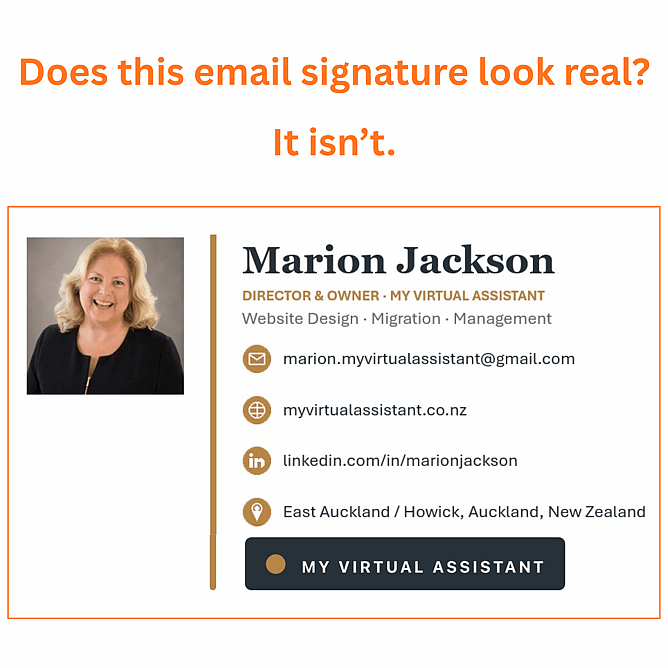
The scammer had created an email address that was very similar to mine: marion.myvirtualassistant@gmail.com
This was the first red flag. This is not my email address. I have business and personal email addresses, but I don't use a gmail address at all.
This is where scammers are getting clever. They're using email addresses that almost look right. Not obviously fake, not full of random letters and numbers, but close enough that, if you're busy and reading quickly, you might not notice.
They had also created a professional-looking email signature using an AI-generated photo of me, my correct website address, my correct LinkedIn address, my location and details about the type of work I specialise in.
I have never included my LinkedIn address in my email communications, so that was another red flag. It's just a tiny detail, but that's the point. Scammers are relying on us not noticing the smallest details.
My brand colours are orange and green, the scammers used navy and beige. Another red flag.
Thankfully, my clients know me
The biggest red flag was actually very simple: it was a Saturday.
Most of my clients know me well enough to know that I don't work weekends. So, receiving an email from me on a Saturday immediately made them suspicious.
Unfortunately, a couple of clients did interact with the scammer before realising something wasn't quite right, but they soon spotted another red flag when ‘Marion’ started quoting in US dollars. Anyone who knows me knows I don’t work in US dollars.
Scammers are getting smarter
This wasn't a random email sent to thousands of people hoping someone would click on a link.
These emails were specifically targeted.
The scammers identified my clients and used information about my business to make the emails appear genuine.
This type of scam is called a targeted business impersonation, potentially leading to a website service scam or payment phishing.
Why you need to be diligent
You can no longer rely on terrible spelling, strange wording, dodgy links or obviously fake email addresses.
The frightening thing is that a lot of the information in the email might actually be correct. The website address can be genuine, the photo can look like the person you know, and the email signature might look completely professional.
And yet, it's still a scam.
If you receive an email that doesn't seem quite right, don't ignore that feeling.
Take a moment to check. Ask yourself:
Is the email address actually correct?
Is the timing unusual?
Does the writing sound like the person?
Are they asking you to do something they wouldn't normally ask?
Are payment details or currencies different?
Does the email signature look unfamiliar?
Are fonts and brand colours correct?
Is something being mentioned that wouldn’t normally be mentioned?
Is there a tiny detail that just doesn't add up?
Trust your gut.
If you're ever unsure, don't reply to the suspicious email to check whether it's genuine.
Instead, contact the person the email has come from via phone call, text, email, via a link on their website, or another contact method you already know is legitimate.
That tiny moment of hesitation could be exactly what saves you, or your business, from becoming the next victim.
And if you're one of my clients who received one of these fake emails pretending to be me, thank you for being alert and for letting me know.
It certainly gave me a wake-up call.
I’ve also filed a report with the National Cyber Security Centre NZ.
The scam wasn't convincing because it was perfect, it was convincing because so many tiny details were almost right.